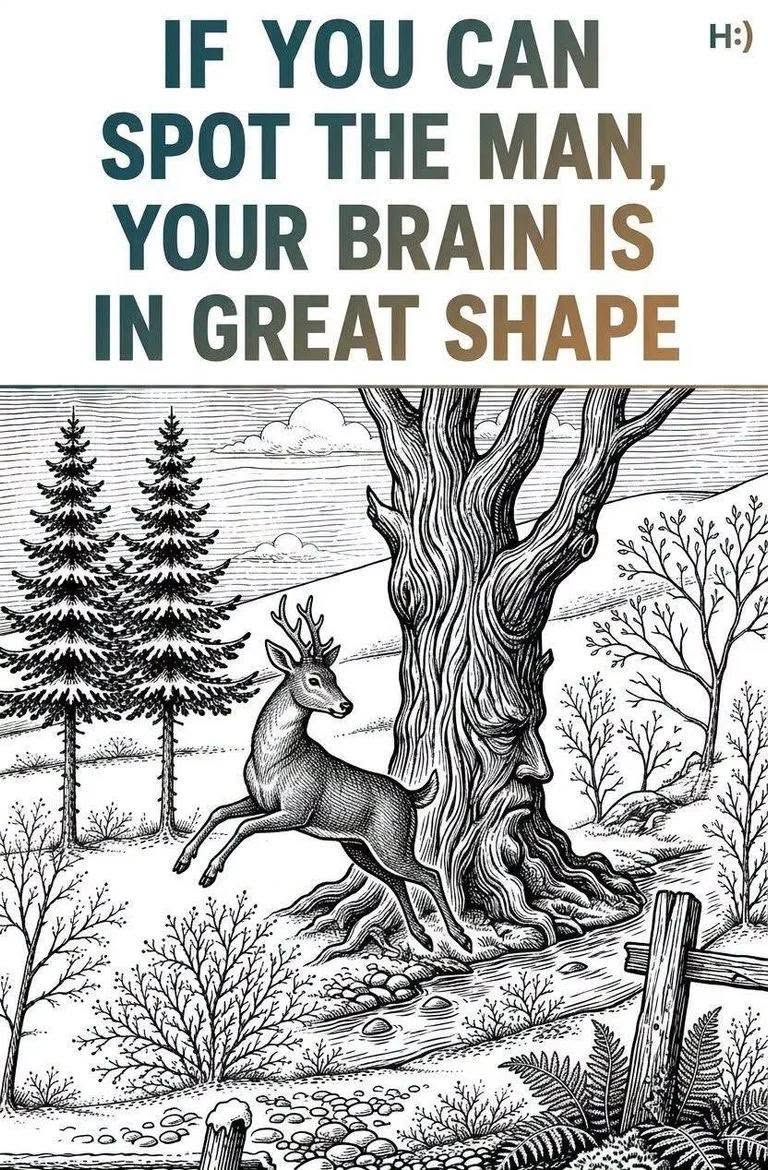
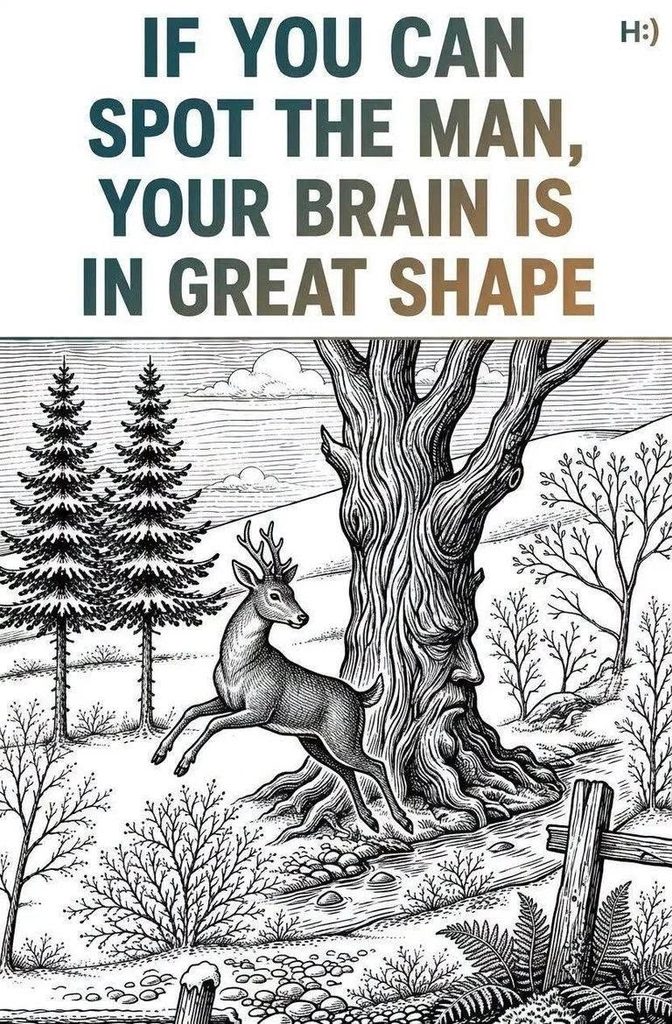
At first glance, this black-and-white illustration appears to show a deer leaping beside a large tree in a peaceful woodland. But the image contains a visual puzzle: somewhere in the scene, a man’s face is hidden among the shapes.
The challenge is to find him without looking at the answer too quickly. Take a close look at the tree, its branches, and the surrounding landscape. Sometimes, the secret is hiding in plain sight.
Where Is the Hidden Man?
Start by examining the large tree in the center of the picture. Its twisted trunk, knots, and irregular branches create shapes that can be interpreted in different ways.
Look carefully at the right side of the trunk. Some of the tree’s natural contours resemble facial features, including a nose and mouth. The illusion works because your brain tries to recognize familiar patterns in complex shapes.
If you spotted the man’s face quickly, you may be particularly attentive to visual details. If it took you longer, there is no need to worry—these puzzles are designed to challenge perception.
Why Do Optical Illusions Trick Our Brains?
Optical illusions take advantage of the way the brain organizes visual information. Rather than processing every detail independently, the brain looks for familiar patterns, objects, and faces.
This ability is useful in everyday life, but it can also make us see faces in clouds, tree bark, rocks, and other irregular shapes. This phenomenon is known as pareidolia.
In this picture, the tree’s texture and contours encourage viewers to interpret part of the trunk as a human face.
Does Finding the Man Mean Your Brain Is in Great Shape?
The image suggests that spotting the man is a sign of a healthy or especially sharp brain. However, finding a hidden face in a picture is not a scientifically validated test of intelligence, memory, or overall brain health.
Your ability to solve the puzzle may depend on attention, visual experience, familiarity with optical illusions, and how quickly you recognize patterns.
These puzzles can be entertaining ways to practice observation, but they should not be used to assess cognitive health.
Try Another Visual Challenge
Once you have found the hidden face, look at the image again and notice how your perception changes. The tree may initially look like an ordinary tree, but after recognizing the facial features, it can become difficult to see the trunk in quite the same way.
That change is part of what makes optical illusions so enjoyable: the same image can produce different interpretations depending on what you notice first.
Final Thoughts
The hidden-man puzzle demonstrates how easily the brain can discover familiar shapes within an ordinary scene. The large tree is the key area to inspect, particularly its twisted trunk and natural contours.
Whether you found the face immediately or needed more time, the real fun lies in exploring how visual perception works.
Did you spot the hidden man on your first attempt, or did the deer catch your attention first?