
For years, scientists have used satellite tracking to investigate one of nature’s most fascinating mysteries: how large birds travel thousands of miles across continents, navigate unfamiliar landscapes, and return to familiar regions year after year.
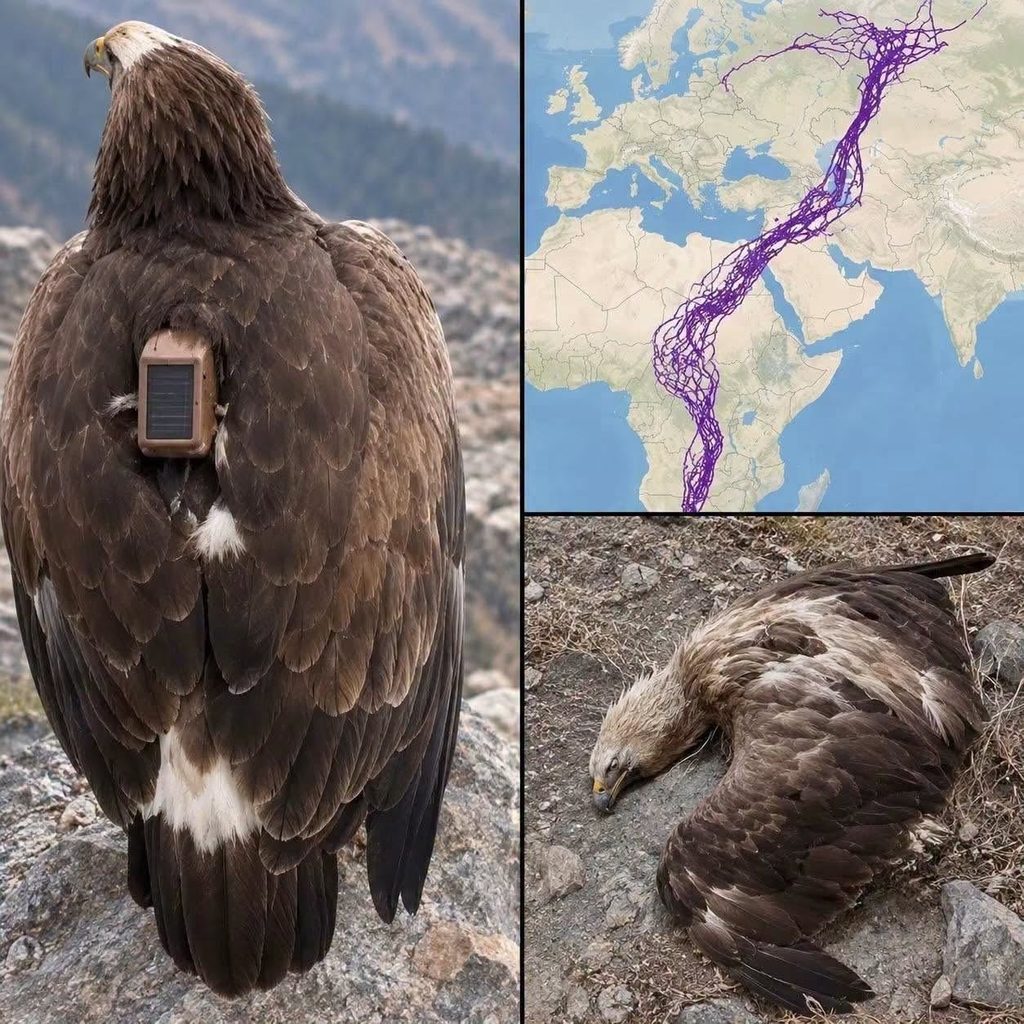
A viral image showing a tracked eagle, a map covered with migration routes, and a fallen bird has sparked curiosity about a supposed 20-year scientific mystery. While the story’s specific claim remains unverified, the science behind tracking migrating eagles is real—and the discoveries are remarkable.
How Do Scientists Track Eagles Across Continents?
Researchers can attach lightweight satellite transmitters or GPS devices to certain birds of prey using carefully designed harnesses. Depending on the equipment, these devices record or transmit information about a bird’s location and movements.
Over time, researchers can use the data to build maps showing where an eagle travels, how long it stays in particular areas, and which routes it follows during seasonal migration.
These tracking studies help scientists understand habitat use, breeding behavior, migration corridors, and the environmental challenges birds face.
For example, a study published in 2003 tracked steppe eagles moving between Asia and Africa. Researchers documented migration routes that crossed the Arabian Peninsula and the Red Sea region, revealing recurring patterns in how the birds traveled between their seasonal ranges.
Why Do Eagles Travel Such Long Distances?
Migration is driven by several factors, including food availability, breeding opportunities, temperature, and seasonal changes in habitat.
Some eagle populations travel between northern breeding grounds and warmer regions where food is more readily available during winter. Others remain in the same broad region throughout the year.
The exact pattern depends on the species, the individual bird, and its environment.
Satellite tracking has shown that migration is not always a straight line. Birds may follow coastlines, mountain ranges, valleys, and narrow geographical passages that help them navigate or conserve energy.
How Can an Eagle Fly Thousands of Miles?
Large soaring birds have evolved remarkable ways to travel without continuously flapping their wings.
They can take advantage of rising air currents, including thermals created by the sun warming the ground and atmospheric waves associated with terrain and wind.
By gaining altitude in rising air and then gliding forward, an eagle can cover substantial distances while reducing the energy required for flight.
A scientific study published in 2022 examined GPS data from a golden eagle and documented how it used atmospheric waves to gain height and glide over a long flight segment. The findings demonstrate how tracking technology can reveal flight behaviors that would be difficult to study through observation alone.
What Happens When a Tracked Eagle Stops Moving?
Tracking devices can provide clues about whether a bird is moving, remaining in one place, or potentially experiencing a problem. Some transmitters include sensors that help researchers investigate possible mortality events.
However, a signal that stops moving does not automatically mean that the bird has died. The device could have failed, lost power, or stopped transmitting for another reason. Researchers may need field observations or additional evidence to determine what happened.
If a tracked eagle is found injured or dead, scientists may investigate possible causes, including collisions, poisoning, disease, starvation, or other environmental hazards.
The photograph accompanying the viral claim does not establish what happened to the eagle shown or whether it is connected to the migration map.
Did Scientists Really Track One Eagle for 20 Years?
Long-term tracking of individual birds is a genuine research goal, but the viral caption does not identify the eagle, the research team, the tracking project, or a scientific publication confirming the alleged 20-year record.
It is also important to distinguish the lifespan of a bird from the operating life of its tracking device. A transmitter may stop working long before the bird dies, and researchers sometimes replace or update tracking equipment.
Without a verifiable source identifying this particular eagle, the claim that scientists were puzzled by its movements for 20 years should be treated as unconfirmed.
Why These Discoveries Matter for Wildlife Conservation
Migration maps can help conservationists identify important feeding areas, breeding grounds, and routes where birds face particular risks.
This information can guide decisions about habitat protection, infrastructure development, and conservation planning across national borders.
Because migratory birds may travel through several countries in a single season, protecting only one part of their range may not be enough. Understanding their complete journey helps researchers identify where conservation efforts can have the greatest impact.
The Bottom Line
Satellite tracking has transformed our understanding of eagle migration. Scientific studies have documented remarkable journeys across continents and revealed how these birds use landscapes and atmospheric conditions to travel efficiently.
However, the specific story of an eagle tracked for 20 years and surrounded by a scientific mystery cannot be confirmed from the viral image alone.
The real scientific achievement is already extraordinary: tracking technology allows researchers to follow the journeys of wild birds and uncover the hidden patterns that help them survive.
Have you ever seen an eagle or another large bird of prey in the wild? Share your experience in the comments.