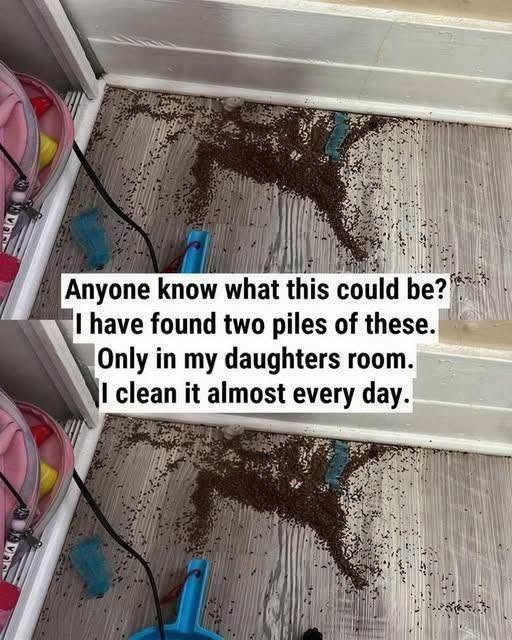
Imagine cleaning your child’s bedroom, only to find two piles of tiny dark particles on the floor.
You clean them up.
Then they appear again.
That’s exactly why a discovery like this can be concerning. At first glance, the material might look like dirt, sawdust, or something that was accidentally spilled. But if the piles keep returning—especially in the same area—there could be a source hidden nearby.
🧐 What Could These Piles Be?
One possibility worth investigating is insect frass, which is the technical term for insect waste or debris.
In particular, small, fairly uniform pellets found beneath wooden areas can sometimes be associated with drywood termites.
Drywood termites live inside wood and can push their fecal pellets out through tiny openings in their galleries. Those pellets can accumulate on floors or other flat surfaces beneath the infested wood. UGA Extension
However, a photograph alone isn’t enough to confirm termites. Other wood-boring insects can also produce sawdust-like material or frass.
🐜 Why Do Termite Pellets Look Like Tiny Grains?
Drywood termite fecal pellets are surprisingly distinctive.
They’re small, hard and often fairly uniform in size. Under magnification, they can have several ridges or flattened surfaces.
That’s why a pile of them can look almost like someone sprinkled a strange type of sand or coffee grounds on the floor.
And there’s an important clue:
The piles can come back after you clean them.
If the material repeatedly appears in the same location, the source may be above or inside the floor, wall, furniture, door frame, ceiling or another wooden structure.
University of Georgia Extension notes that the continued appearance of uniform pellets on a flat surface beneath infested wood is one of the most common outward signs of drywood termites. UGA Extension
🔎 Look Above the Pile
If you discover something similar in your home, don’t just vacuum it up and forget about it.
Look carefully around the area for:
- Tiny holes in wooden surfaces
- Fresh piles of pellets
- Damaged or hollow-sounding wood
- Blistering or unusual areas on wood
- Small cracks or openings
- Evidence of insects or discarded wings
- Similar material appearing in another location
Drywood termites can create small “kick-out” holes through which they remove their pellets from galleries inside wood. EPA
🪵 It Doesn’t Necessarily Mean Your House Is Infested
This is important.
Don’t look at a photograph like this and immediately conclude that the room has termites.
There are several insects that can leave behind sawdust-like material or frass, including some wood-boring beetles.
The location, shape and consistency of the particles—and whether there are holes or damage in nearby wood—can help professionals determine what’s actually happening. EPA
⚠️ What Should You Do?
If you find repeated piles like these:
1. Take clear photographs.
Photograph the pile from above and take close-ups of the individual particles.
2. Don’t immediately throw everything away.
Keep a small sample in a sealed bag or container if you need to show it to a pest professional.
3. Inspect the surrounding wood.
Check furniture, baseboards, window frames, doors and other wooden structures near the location.
4. Check whether the material returns.
Clean the area and monitor it. Reappearance can be an important clue.
5. Consider a professional inspection.
If termite activity is suspected, it’s better to identify the source before assuming the problem is simply dirt.
The EPA recommends professional pest-management assistance for termite treatment because properly identifying the termite type and selecting an appropriate treatment can be important. US EPA
🏠 Why You Shouldn’t Ignore Repeated Piles
The biggest clue isn’t necessarily how much material you find.
It’s whether it keeps coming back.
A single pile could have many explanations. But repeatedly finding small piles in the same room—particularly beneath wooden structures—deserves a closer look.
So if you ever clean something like this up and find another pile a few days later, don’t just assume someone made a mess.
There may be something happening inside the wood above it. 👀
Have you ever found strange little piles like this in your home?
What did they turn out to be? Share your experience in the comments. 👇