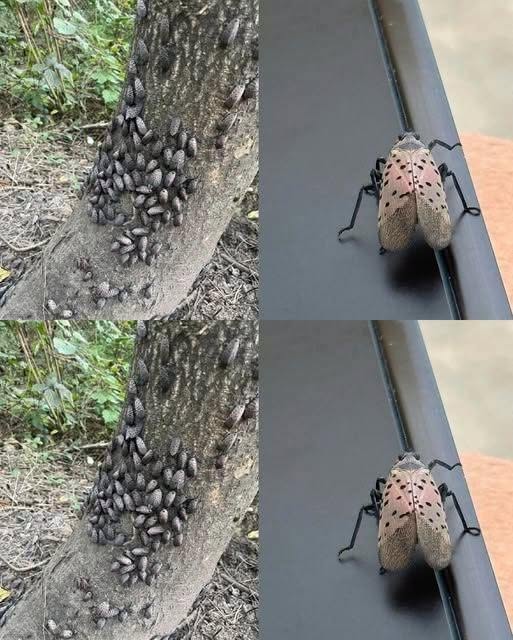
If you’ve spotted an insect that looks like the one in this image, don’t ignore it.
The insect shown appears to be the spotted lanternfly (Lycorma delicatula), an invasive planthopper that has become a major concern in parts of the United States.
But there’s an important point: the correct response depends on where you live. Seeing one does not automatically mean you have a major infestation.
🐞 What Does a Spotted Lanternfly Look Like?
Adult spotted lanternflies are about 1 inch long and have distinctive wings.
When their wings are closed, they appear grayish or tan with black spots. When they open their wings, bright red and black patterns can become visible.
They are often found in groups on tree trunks, especially around their preferred host, the tree-of-heaven.
🌳 Why Are People Concerned About Them?
Spotted lanternflies feed on the sap of many plants, including:
- 🍇 Grapevines
- 🍎 Fruit trees
- 🌳 Hardwood trees
- 🌿 Ornamental plants
As they feed, they produce a sticky sugary substance called honeydew.
This can coat leaves and surfaces underneath the insects and encourage the growth of sooty mold, which can interfere with plant health.
🥚 The Eggs Are Especially Important
One reason authorities take these insects seriously is that females can lay egg masses on almost any hard surface.
They can be found on:
- Trees
- Fences
- Outdoor furniture
- Vehicles
- Garden equipment
- Stones
- Firewood
- Trailers and other outdoor objects
Fresh egg masses can look like a gray or muddy smear on a surface.
Each egg mass can contain roughly 30–50 eggs.
⚠️ What Should You Do If You Find One?
First, make sure you’ve actually identified it correctly.
There are other insects that look similar, and not every spotted insect is a spotted lanternfly.
If you are in an area where spotted lanternflies are considered invasive and you confirm one:
🐞 Adult insect
Local authorities may recommend killing the insect to prevent reproduction.
🥚 Egg mass
Reachable egg masses can be scraped off and destroyed properly. Simply scraping them onto the ground isn’t enough because viable eggs may still hatch.
If you’re inspecting a tree, don’t climb dangerously high to reach egg masses.
🚗 Don’t Accidentally Transport Them
Spotted lanternflies are excellent hitchhikers.
Before moving vehicles, outdoor furniture, camping equipment, trailers or other objects from an infested area, check carefully for insects and egg masses.
This is one of the ways infestations can spread to new locations.
🌍 One Important Warning
The viral caption saying “we were all warned that if we see even ONE, immediately get rid of it” is too general.
The spotted lanternfly is invasive in some regions, but regulations and reporting requirements vary by location.
So if you find one outside a known infestation area, take a clear photograph and contact your local agricultural extension service or plant-health authority for identification and instructions.
🚨 Bottom Line
The insect in the photograph appears to be a spotted lanternfly, a species that can cause serious agricultural and ecological problems where it is invasive.
Don’t panic—but don’t deliberately transport it either.
If you see one, photograph it, confirm the identification, and follow your local authorities’ guidance. 🐞🌳
Have you ever seen one of these in your backyard? 👀