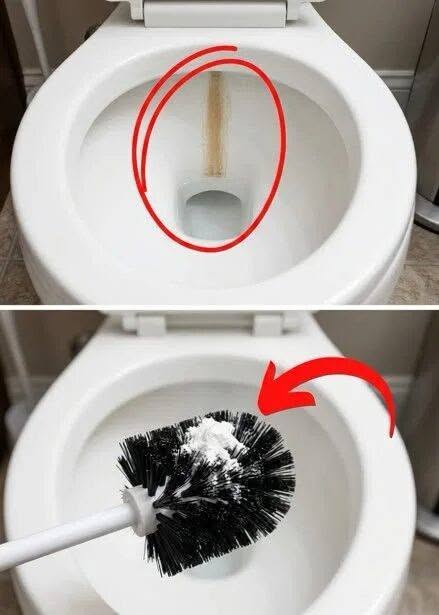
Viral “life hack” videos and social media posts advocating for the use of shaving foam to clean toilets frequently surface online. The shared image displays two panels of a toilet bowl: one featuring a dark mineral stain highlighted with a red circle, and the other showing a toilet brush covered in white shaving foam with a red arrow pointing toward the bowl, captioned: “Shaving foam in the bathroom: The simple trick for a cleaner toilet…see mor”.
While some internet users occasionally recommend shaving cream to neutralize odors on bathroom floor tiles, using shaving foam to remove mineral stains or deep-clean a toilet bowl is completely ineffective and wasteful. Shaving cream lacks the necessary acidic or descaling agents required to dissolve tough mineral build-up.
Here is the chemical breakdown of why this hack fails, the mechanics behind viral cleaning clickbait, and practical guidelines to effectively descaling your toilet:
1. The Problem: Clickbait Formatting and Repurposed “Miracle” Hacks
Viral household content relies on predictable engagement mechanics designed to drive traffic and video views:
- Truncated Headlines (Clickbait Hooks): Incomplete headlines ending with phrases like “see mor” create artificial suspense, prompting users to click through to external ad-heavy blogs.
- Visual Alarmism (Red Circles and Arrows): Superimposing bright red circles over stains and arrows pointing to everyday items grabs attention during rapid scrolling.
- Novelty of Misused Products: Suggesting a personal care item (shaving cream) for an unrelated task (toilet bowl cleaning) generates curiosity and triggers high comment activity from skeptical viewers.
2. Explanation: Why Shaving Foam Cannot Remove Toilet Stains
From a chemical and sanitary standpoint, shaving cream is not formulated to clean porcelain or remove mineral deposits:
- Inability to Dissolve Limescale: The dark or yellow stains at the bottom of a toilet bowl consist of hard water scale (calcium carbonate) combined with uric acid deposits. Dissolving these mineral deposits requires an acidic agent (such as citric acid or white vinegar). Shaving foam has a neutral or slightly basic pH, making it chemically incapable of breaking down mineral scale.
- Lack of Disinfecting Properties: Unlike dedicated bathroom cleaners, standard shaving cream does not contain antibacterial or disinfectant agents designed to sanitize toilets.
- Plumbing and Environmental Waste: Flushing cosmetic foams, oils, and polymers down the drain introduces unnecessary chemical waste into plumbing systems without providing any structural cleaning benefit.
3. Advice & Steps: How to Properly Descale and Clean Your Toilet Bowl
To safely remove stubborn stains and restore ceramic surfaces without relying on ineffective hacks, follow these evidence-based steps:
1. Use Citric Acid or Heated White Vinegar
- Remove excess water from the bottom of the bowl using a toilet brush. Pour in $2$ to $3\text{ tablespoons}$ of citric acid powder or a half-liter of warm white vinegar.
2. Allow Sufficient Dwell Time
- Let the acidic solution sit in the bowl for at least $1$ to $2\text{ hours}$ (or overnight for severe mineral build-up) without flushing to give it time to break down the hard water deposits.
3. Scrub and Flush
- Scrub the bowl thoroughly with a stiff-bristled toilet brush to loosen the dissolved scale, then flush to reveal a clean ceramic surface.
Disclaimer & Safety Guidelines
This article is provided for general educational, household literacy, and fact-checking purposes. Viral cleaning hacks frequently exaggerate the effectiveness of repurposed cosmetic products. Never mix chlorine bleach with acidic cleaners (such as vinegar or citric acid), as this combination produces toxic chlorine gas.