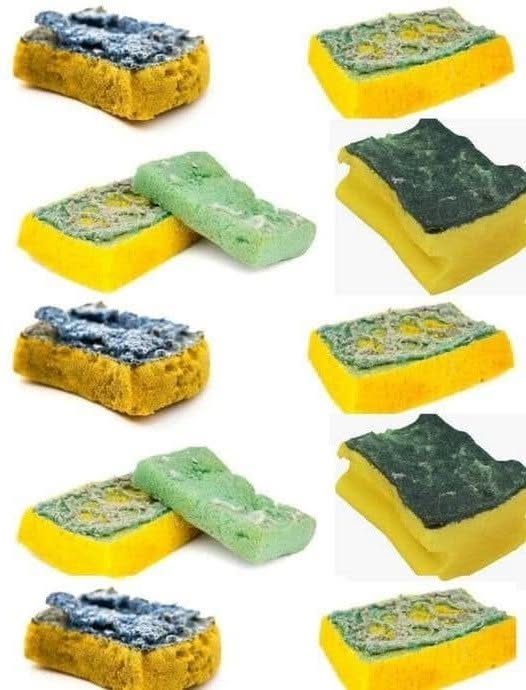
You may have seen posts claiming that old kitchen sponges are “worth gold” because they can be reused in dozens of clever ways.
There is some truth to the idea that an old sponge can still be useful—but you should be careful about reusing a sponge that has been used for washing dishes.
🧽 First: Don’t Keep Using a Dirty Kitchen Sponge
Kitchen sponges stay wet and trap food particles, creating an environment where bacteria can multiply.
Even a sponge that looks clean and doesn’t smell bad can contain microorganisms, so appearance alone isn’t a reliable way to judge whether it’s hygienic. Bundesinstitut für Risikobewertung
If a sponge has been used to clean up raw meat or poultry juices, it’s better to discard it rather than move it to another household task. Eat Right
♻️ But Old Sponges Can Have Other Uses
If a sponge is still in reasonable condition and has not been contaminated with raw food, you can repurpose it for non-food tasks.
🌱 1. Protect Plant Pots
Cut a piece of sponge and place it underneath a plant pot to help protect the surface from scratches and absorb small amounts of excess water.
🧼 2. Cleaning Shoes
An old sponge can be useful for cleaning the rubber soles of shoes or removing dirt from washable footwear.
🚿 3. Bathroom Cleaning
Keep an old sponge specifically for cleaning sinks, tiles or other non-food surfaces.
Don’t use the same sponge afterward for dishes.
🪟 4. Cleaning Windows and Glass
A soft sponge can help with washing windows, mirrors and other washable surfaces.
🧽 5. Hard-to-Reach Areas
Cutting a sponge into smaller pieces can make it useful for cleaning corners, grooves and narrow spaces.
🧊 6. Protect Fragile Objects
A clean, dry piece of sponge can be placed around delicate objects when storing or transporting them to provide a little cushioning.
⚠️ One Important Rule
Don’t turn a bacteria-filled kitchen sponge into a “reusable miracle tool.”
If the sponge is:
- Smelly 🤢
- Slimy
- Moldy
- Falling apart
- Heavily stained
- Used to clean raw meat or poultry
👉 Throw it away.
Food-safety guidance recommends replacing kitchen sponges regularly rather than keeping them indefinitely. Ask FSIS
💡 A Better Alternative
For everyday dishwashing, dish brushes can be more hygienic than traditional sponges because they dry faster and generally provide a less favorable environment for bacteria. DOI
🧽 Bottom Line
Old sponges aren’t literally “worth gold.” 😄
But a sponge that is no longer suitable for the kitchen can sometimes be given a second life for dirty, non-food cleaning jobs—as long as you keep it completely separate from your dishwashing tools.
Would you reuse an old sponge for cleaning around the house, or would you simply throw it away?