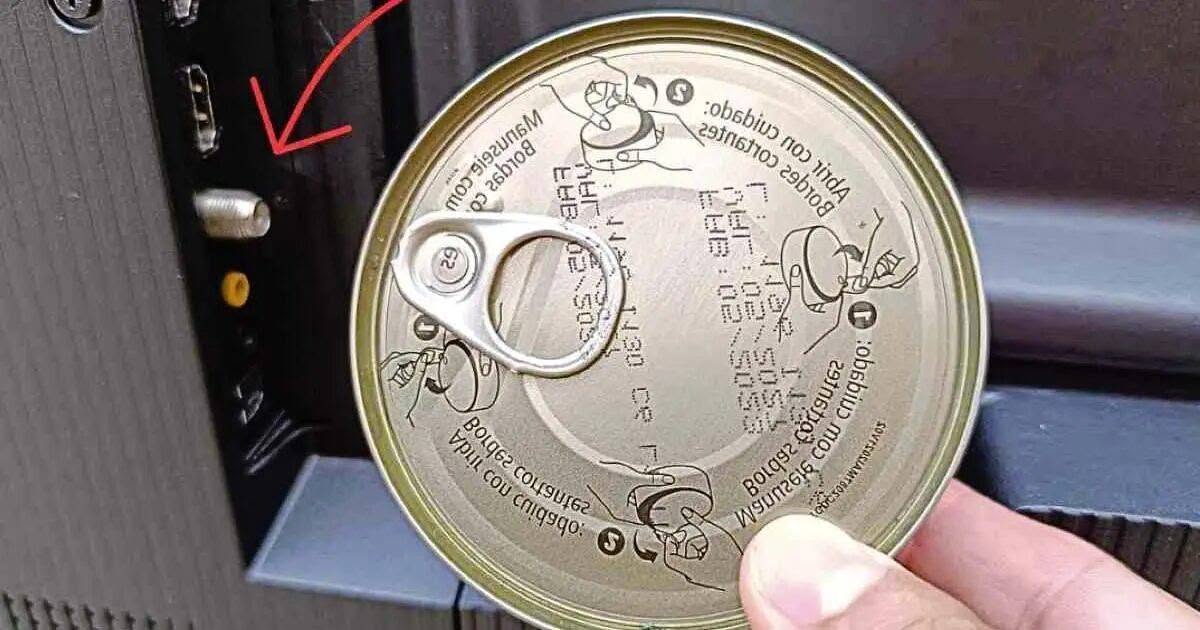
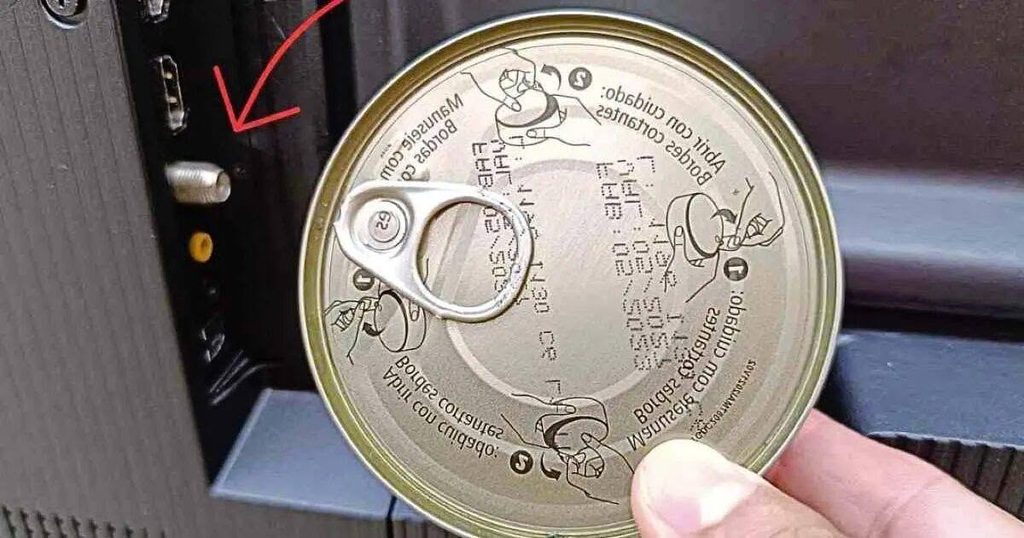
Social media is full of quick DIY hacks claiming you can boost your television signal using everyday household items. One viral photo shows a metal tin (like a tuna can) held right up to the coaxial antenna port on the back of a TV.
While it might look like a joke, this trick relies on basic electromagnetic principles—though its real-world effectiveness is far from a permanent fix.
Here is the physics behind the tuna can TV hack, why it sometimes works, and how to actually get a crystal-clear picture without risking your electronics:
1. The Problem: What Causes Poor TV Signal?
Weak or flickering TV reception usually comes down to environmental factors interfering with radio frequency (RF) signals:
- Distance from Transmitters: The farther you live from local broadcast towers, the weaker the signal reaching your home antenna.
- Physical Obstacles: Concrete walls, metal roofs, hills, and dense trees degrade over-the-air signal strength before it reaches your TV.
- Electromagnetic Interference: Unshielded cables or nearby electronics can create noise and disrupt signal clarity.
2. Explanation: How Metal Objects Interact with Radio Waves
Using a metal container (like a tin or aluminum can) near an antenna connection plays on basic signal reflection:
- Improvised Wave Reflector: Cans are made of conductive metals like aluminum or steel. Placed strategically near an unshielded antenna connector or indoor antenna, the metal can act as a crude parabolic reflector, bouncing stray radio waves back toward the receiving pin.
- Expanding Surface Area: If the metal touches the outer ground shield or center pin of the coaxial jack, it temporarily increases the conductive surface area capturing RF frequencies.
- Extremely Limited Results: While a metal can might occasionally stabilize a weak signal for a moment, it is uncalibrated and cannot replace an antenna tuned to specific broadcast wavelengths.
3. Advice & Solutions: How to Actually Boost Your TV Signal
Instead of balancing pantry items on your entertainment center, try these reliable fixes for a stable, high-definition picture:
- Upgrade Your Coaxial Cable: Use a high-quality, double-shielded coaxial cable with gold-plated connectors to minimize signal loss and eliminate interference.
- Position Your Indoor Antenna Correctly: Place your antenna as high as possible, ideally on or near a window facing the direction of your nearest broadcast tower.
- Install an Inline Signal Amplifier: If you live in a weak signal area, adding a powered antenna booster between the wall jack and your TV will cleanly amplify over-the-air channels.
- Switch to Streaming or Internet TV: Modern smart TVs and streaming devices allow you to watch live channels over Wi-Fi or Ethernet, eliminating antenna issues entirely.
Disclaimer & Safety Guidelines
This article is provided for educational and technical informational purposes only. Never force metal objects into your TV’s coaxial port, as doing so can damage the internal tuner board, bend delicate pins, or cause electrical shorts.