For many people, the idea of having a traditional colonoscopy can be uncomfortable.
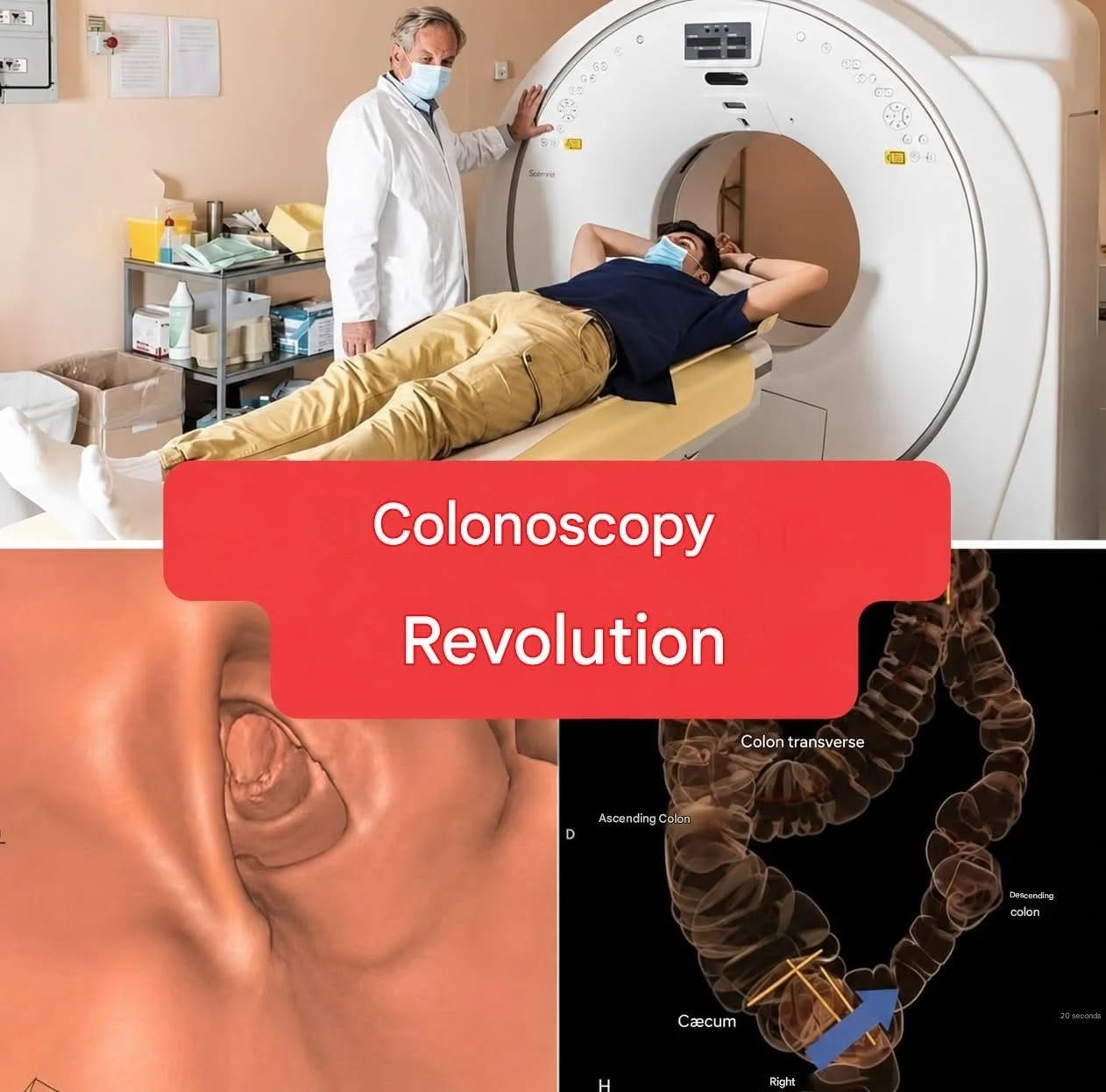
But modern medical imaging offers another option: CT colonography, also called a virtual colonoscopy.
Instead of passing a camera through the entire colon, this technique uses a CT scanner to create detailed images of the colon and rectum.
And yes—it can be considerably less invasive than a conventional colonoscopy. But it does not completely replace it.
🔬 WHAT IS A VIRTUAL COLONOSCOPY?
CT colonography uses low-dose CT imaging to produce detailed 2D and 3D images of the large intestine.
During the examination, a small tube is inserted a short distance into the rectum. The colon is gently inflated with air or carbon dioxide, allowing the CT scanner to obtain clearer images of the colon wall.
A radiologist then examines the images for abnormalities such as polyps or tumors.
The procedure generally doesn’t require sedation.
😮 HOW IS IT DIFFERENT FROM A NORMAL COLONOSCOPY?
With a traditional colonoscopy, a flexible camera is passed through the rectum and through the colon.
The major advantage is that the doctor can see abnormalities directly and treat them during the same procedure.
If a polyp is discovered, it can often be removed immediately. A biopsy can also be taken when necessary.
With virtual colonoscopy, the doctor obtains images from outside the body instead.
That makes the examination less invasive—but it also creates an important limitation.
⚠️ WHAT HAPPENS IF A POLYP IS FOUND?
This is the part many viral posts leave out.
CT colonography cannot remove a polyp.
If an important polyp or suspicious abnormality is discovered, the patient will generally need a conventional colonoscopy afterward so the doctor can remove it or take a tissue sample.
So virtual colonoscopy is not a complete replacement for traditional colonoscopy.
🛏️ DOES IT MEAN NO PREPARATION?
Unfortunately, no.
Before either examination, the colon usually needs to be thoroughly cleaned so that stool doesn’t hide abnormalities.
Patients undergoing CT colonography may therefore still have to follow a bowel-cleansing preparation beforehand.
The examination itself, however, generally does not require the sedation commonly used for conventional colonoscopy.
❤️ WHY ARE DOCTORS INTERESTED IN THIS METHOD?
There are several potential advantages.
✅ Less invasive
There is no long camera traveling through the entire colon.
✅ Usually no sedation
Patients generally remain awake during the examination.
✅ Lower risk of perforation
CT colonography has a much lower risk of causing a perforation of the colon than conventional colonoscopy.
✅ Detailed images
Modern CT technology can produce both two-dimensional and three-dimensional views of the colon.
✅ Useful for some patients
It can be particularly useful for people for whom conventional colonoscopy is difficult or carries additional risks.
🧬 CAN IT DETECT CANCER?
Yes.
CT colonography is used to look for colorectal polyps and tumors.
Detecting certain polyps is particularly important because some types can eventually develop into colorectal cancer.
Finding these abnormalities early can allow doctors to determine whether further examination or treatment is necessary.
⚠️ BUT IT HAS SOME LIMITATIONS
Like every medical examination, virtual colonoscopy isn’t perfect.
It can sometimes miss smaller polyps, and it exposes the patient to a small amount of radiation because it uses CT imaging.
It can also reveal abnormalities outside the colon that were not the original reason for the examination. These findings may sometimes require additional testing.
And most importantly:
A positive virtual colonoscopy may still lead to a traditional colonoscopy.
🆚 VIRTUAL VS. TRADITIONAL COLONOSCOPY
🩺 Traditional Colonoscopy
✅ Direct view of the colon
✅ Polyps can be removed immediately
✅ Biopsies can be performed
✅ No CT radiation
❌ More invasive
❌ Often involves sedation
❌ Small risk of complications
🖥️ Virtual Colonoscopy
✅ Less invasive
✅ Usually no sedation
✅ Detailed 2D and 3D images
✅ Lower risk of colon perforation
❌ Still requires bowel preparation
❌ Uses X-ray radiation
❌ Cannot remove polyps
❌ Abnormal findings may require conventional colonoscopy
🧠 IS THIS REALLY A “NEW” REVOLUTION?
Not exactly.
Virtual colonoscopy isn’t a brand-new invention.
CT colonography has been studied and used as a colorectal cancer screening option for years. What continues to improve is the quality of CT imaging, image reconstruction and the ability of doctors to detect abnormalities.
So the real story isn’t that colonoscopy has suddenly been replaced.
It’s that patients now have another established screening option in appropriate situations.
📅 HOW OFTEN IS IT USED FOR SCREENING?
For average-risk adults, CT colonography is one of the recognized colorectal cancer screening options.
Screening schedules depend on the person’s age, risk factors, family history and the guidelines used in their country.
Some major guidelines recommend CT colonography approximately every five years for average-risk screening, while conventional colonoscopy is typically performed at longer intervals when results are normal.
People with symptoms or increased risk may need a different approach.
🚨 DON’T CHOOSE A TEST JUST BECAUSE IT LOOKS EASIER
If someone has symptoms such as:
🩸 Blood in the stool
⚠️ Persistent changes in bowel habits
😣 Ongoing abdominal pain
📉 Unexplained weight loss
🎈 Persistent digestive problems
they should discuss these symptoms with a healthcare professional rather than simply choosing a screening test based on a social-media post.
The appropriate examination depends on the individual situation.
❤️ THE FUTURE OF COLON EXAMINATION
Virtual colonoscopy shows how medical imaging is making some examinations less invasive and more comfortable.
But it doesn’t eliminate the need for conventional colonoscopy in every situation.
Think of it this way:
Virtual colonoscopy can look.
Traditional colonoscopy can look AND treat.
For some people, that difference can be extremely important.
💬 WHAT WOULD YOU CHOOSE?
If your doctor told you that both options were appropriate, would you prefer:
A) Traditional colonoscopy 🩺
B) Virtual colonoscopy 🖥️
C) Whatever your doctor recommends ❤️
👇 Tell us in the comments!
#Colonoscopy #VirtualColonoscopy #CTColonography #MedicalTechnology #HealthFacts #ColorectalCancer #CancerScreening #Healthcare #MedicalInnovation #HealthAwareness #DidYouKnow