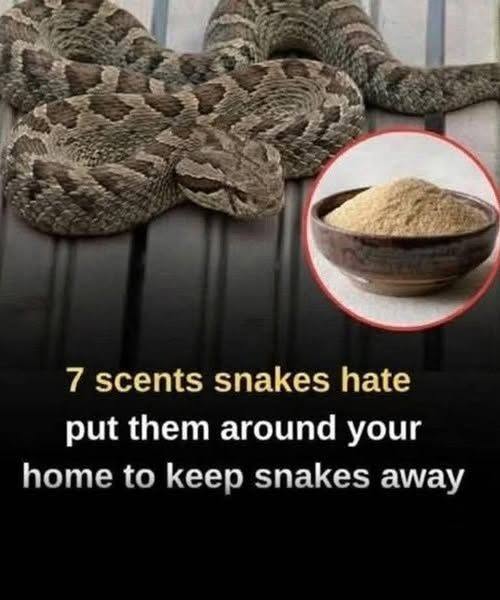
You may have seen posts claiming that snakes have an extremely sensitive sense of smell and that placing certain strong-smelling substances around your home will make them stay away.
The viral image even suggests using seven different scents as a natural snake repellent.
But there’s an important problem with this advice:
⚠️ Most of these “snake-repelling scents” have NOT been proven to reliably keep snakes away.
Snakes do detect chemical cues in their environment, but that doesn’t mean a strong smell automatically makes them flee. Studies and university extension programs have found that many popular home remedies simply don’t work consistently. extension.colostate.edu
So let’s separate the viral claims from what actually helps.
🌿 1. Cinnamon
Cinnamon is frequently recommended online because of its strong aroma.
But there isn’t good evidence that simply spreading cinnamon around your property will reliably keep snakes away.
Essential-oil mixtures containing cinnamon have also been tested in snake-repellent research without producing reliable field results. Publications et Ressources Éducatives
🌸 2. Clove
Clove and eugenol are another popular DIY recommendation.
They have a very strong smell, but laboratory or field interest in these substances doesn’t mean they are a dependable household snake barrier.
Research involving cinnamon, clove and eugenol mixtures has not established them as a reliable solution for keeping snakes away from homes. Publications et Ressources Éducatives
🧄 3. Garlic
Garlic is another classic internet suggestion.
The theory is simple: strong smell = snake avoidance.
Unfortunately, there isn’t strong evidence that scattering garlic around your yard creates a dependable snake-free zone.
If snakes are finding food, shelter or an easy way into a building, the smell of garlic isn’t likely to solve the underlying problem.
🌶️ 4. Cayenne Pepper
You may also see advice recommending cayenne pepper or chili sprays.
It sounds logical, but controlled testing of cayenne pepper spray among other proposed snake repellents has failed to demonstrate reliable snake deterrence. uaex.uada.edu
And spraying large quantities of irritating substances around your property can create unnecessary risks for people, pets and other wildlife.
🧪 5. Sulfur
Sulfur is one of the most common ingredients in commercial products marketed as snake repellents.
But research has repeatedly questioned its effectiveness.
University extension guidance reports that sulfur has failed to reliably repel several snake species, and it shouldn’t be treated as a guaranteed barrier. extension.colostate.edu
🦨 6. Strong “Predator” Smells
Some viral posts recommend things such as artificial skunk scent or other unpleasant animal odors.
These methods sound convincing because many animals avoid predators.
But experiments involving black rat snakes found that several of these popular remedies failed to repel them. animalrangeextension.montana.edu
🧺 7. Mothballs
This is perhaps the most important myth to avoid.
Many social-media posts recommend putting mothballs around houses, gardens or sheds to drive snakes away.
❌ Don’t do it.
Mothballs are pesticides designed for specific labeled uses, primarily against clothes moths. They are not a safe or reliable snake repellent.
Using them outdoors to repel snakes can expose children, pets and wildlife to toxic chemicals, and using a pesticide contrary to its label can be illegal. Ask IFAS – Powered by EDIS
🏡 SO WHAT ACTUALLY WORKS?
Instead of trying to make your yard smell unpleasant, make it less attractive to snakes.
Snakes often appear where there is a combination of:
🐭 Food — especially rodents
🪵 Shelter — wood piles, rocks, debris and clutter
🌿 Dense vegetation
💧 Moist hiding places
🏠 Easy access into buildings
Removing these attractions is much more reliable than spreading strong-smelling substances around the property. animalrangeextension.montana.edu
✅ Keep grass and vegetation trimmed
Tall grass and dense vegetation give snakes places to hide.
✅ Remove piles of wood, rocks and debris
These can create excellent shelter.
✅ Control rodents
If mice and rats have easy access to food around your home, snakes may follow because rodents are an important food source.
✅ Seal openings
Check foundations, doors, pipes, vents and other potential entry points.
Some extension guidance recommends sealing openings about ¼ inch (6 mm) or larger where snakes could enter. extension.colostate.edu
✅ Store firewood properly
Keep firewood away from the house and elevated when practical so it doesn’t become a convenient hiding place for rodents and snakes. Penn State Extension
🐍 THE TRUTH ABOUT THE “7 SCENTS”
The idea that “snakes hate these seven smells” makes a great viral headline, but science doesn’t support the claim that these scents will reliably create a snake-free area.
Even commercial snake repellents have shown inconsistent results, while several popular home remedies—including sulfur, mothballs and cayenne pepper—have failed in testing. extension.colostate.edu
🚨 And remember:
A snake entering your yard doesn’t necessarily mean you have an infestation.
Many snakes are simply passing through or looking for food, shelter or a suitable temperature.
If you encounter one, don’t try to grab, corner or kill it. Keeping your distance is much safer, particularly when you cannot confidently identify the species.
🧠 BOTTOM LINE
Strong smells may sound like an easy natural solution, but there is no magic scent that reliably keeps snakes away.
The most effective strategy is simple:
Remove food + remove hiding places + seal entry points + keep the surroundings maintained. 🏡🐍
And if you’re tempted to throw mothballs around your yard because of something you saw on Facebook…
❌ DON’T.
That viral trick can be more dangerous than the snake you’re trying to avoid.
💬 Have you ever tried one of these “snake repellent” tricks? Did it actually work?
#SnakeFacts #SnakeSafety #Wildlife #HomeSafety #Snakes #GardeningTips #NatureFacts #OutdoorSafety #HomeTips #DidYouKnow