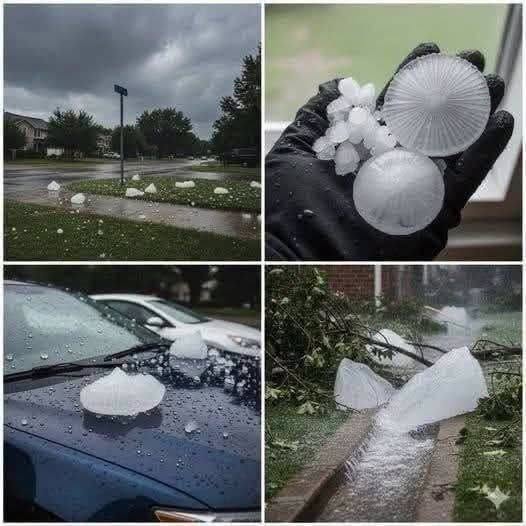
1. Visual Inconsistencies in the Images
An inspection of the four images reveals several obvious physical and structural impossibilities:
- Unusual Geometric Shapes: The depicted structures feature perfectly symmetrical, umbrella-like or mushroom-shaped caps with uniform ridges. Natural hail forms through chaotic accretion in turbulent storm clouds, resulting in spherical, oblate, or irregularly spiked ice masses.
- Lack of Corresponding Damage: Blocks of ice this size, weighing several hundred grams, would shatter windshields, crush car roofs, and destroy surrounding structures. In the panel showing a vehicle, the car hood remains completely smooth and dent-free despite massive ice blocks resting on top of it.
- Inconsistent Ice Textures: The texture of the ice varies unnaturally across the frames, shifting from smooth, plastic-like surfaces to unrealistic translucent patterns.
2. Scientific Explanation: How Hail Actually Forms
Atmospheric physics sets strict limits on the size and structure of hailstones:
- The Accretion Process: Hail develops inside severe thunderstorm clouds (cumulonimbus) containing powerful updrafts. Supercooled water droplets freeze upon contact with condensation nuclei, growing as they are carried up and down through freezing cloud layers.
- Concentric Layering: Cutting a genuine hailstone open reveals concentric layers of alternating opaque and clear ice, reflecting the varying temperatures and water densities encountered during its growth inside the cloud.
- Natural Size Limits: The largest authenticated hailstones recorded in history measure around 20 cm (8 inches) in diameter. They exhibit jagged, irregular ice lobes rather than sculpted geometric patterns.
3. Practical Steps: How to Fact-Check Viral Weather Images
To avoid spreading fake or manipulated weather media, apply these verification steps:
1. Inspect the Surrounding Environment
- Extreme weather leaves widespread damage. If massive ice blocks appear on a vehicle or street without any broken glass, dented metal, or stripped tree foliage, the image is likely fabricated or digitally altered.
2. Check for Vague Locations
- Posts using generic captions like “S-town” or “in this city” without specifying dates, states, or countries are red flags for automated pages designed to farm engagement.
3. Cross-Reference with Official Meteorological Services
- Verify severe weather reports through official national weather agencies, local news outlets, or radar records to confirm whether a major hail event occurred in that region.