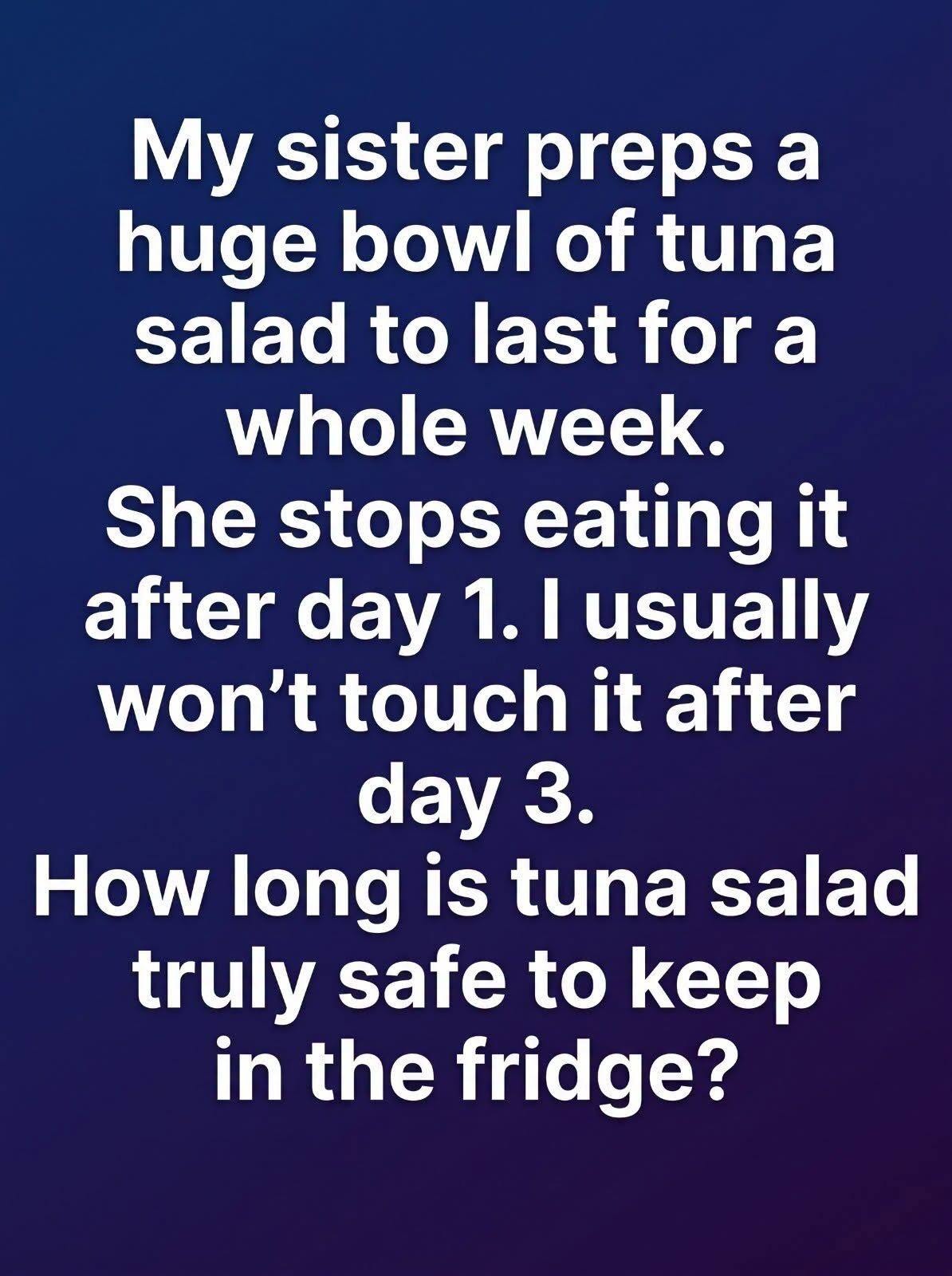
Questions regarding food storage, leftover safety, and meal prep routines frequently generate widespread discussion across social media platforms. The shared image displays white text against a blue gradient background posing a common kitchen dilemma: “My sister preps a huge bowl of tuna salad to last for a whole week. She stops eating it after day 1. I usually won’t touch it after day 3. How long is tuna salad truly safe to keep in the fridge?”.
While prepping large batches of tuna salad for the entire week is a popular time-saving habit, keeping prepared tuna salad in the refrigerator for longer than 3 to 4 days poses a real risk of foodborne illness. Official food safety standards set strict limits on perishable fish and mayonnaise mixtures.
Here is the microbiological breakdown of tuna salad storage, the mechanics behind kitchen debate clickbait, and evidence-based tips to keep your meal prep safe:
1. The Problem: Household Debates and Algorithmic Engagement-Bait
Viral social media posts focusing on kitchen habits and food storage rely on specific psychological triggers to maximize user interaction:
- Pitting Relatives Against Each Other: Highlighting opposing family habits (e.g., eating week-old leftovers vs. throwing them out after day 1) prompts users to comment with their own personal experiences.
- Validating Food Safety Anxieties: Asking a direct question about hidden health risks validates cautious eaters while shocking those who regularly eat older leftovers.
- Driving Comment Section Activity: Debates about smell tests, mayonnaise spoilage, and past food poisoning experiences produce high comment counts that signal algorithms to boost post reach.
2. Explanation: How Long Is Tuna Salad Truly Safe in the Refrigerator?
According to food safety guidelines from public health authorities (such as the USDA and FDA), prepared tuna salad has a very clear shelf life:
- The 3-to-4-Day Rule: Homemade tuna salad—combining canned tuna, mayonnaise, celery, eggs, or seasonings—must be consumed within 3 to 4 days when stored continuously in a refrigerator kept at $4\text{ °C}$ ($40\text{ °F}$) or below.
- Bacterial Growth Risks: Moisture-rich protein foods mixed with mayonnaise create an ideal environment for rapid bacterial proliferation, including Listeria monocytogenes, Staphylococcus aureus, and Salmonella.
- The Fallacy of the “Smell Test”: Disease-causing bacteria (pathogens) generally do not change the smell, appearance, or taste of food. Relying solely on scent or visual cues to eat seafood past day 4 is unsafe.
3. Advice & Steps: How to Safely Prepare and Store Tuna Salad for the Week
To enjoy the convenience of meal prepping without risking foodborne illness, follow these practical steps:
1. Maintain Proper Refrigerator Temperature
- Ensure your refrigerator stays at or below $4\text{ °C}$ ($40\text{ °F}$). Store prepared tuna salad on an interior shelf rather than in the door, where temperature fluctuations occur every time the door opens.
2. Store Ingredients Separately for Long Meal Preps
- If you want meals for 5 to 7 days, drain the canned tuna and keep it sealed in an airtight container. Mix in mayonnaise, dressings, and fresh vegetables only 1 to 2 days before consumption to slow bacterial growth and maintain texture.
3. Follow the Two-Hour Rule
- Never leave tuna salad sitting at room temperature for more than 2 hours (or 1 hour if the ambient temperature is above $32\text{ °C}$ / $90\text{ °F}$). Refrigerate leftovers immediately after serving.
Disclaimer & Safety Guidelines
This article is provided for general educational, food hygiene literacy, and fact-checking purposes. Viral posts on food habits frequently normalize unsafe food handling practices. When evaluating the safety of perishable leftovers, always follow official public health guidelines: when in doubt, throw it out.